
 Posted by
  Category: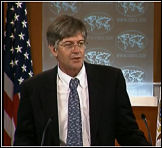
ABOVE:Asst. Sec. Steinberg
On May 24, the State Department announced sanctions against a number of companies including Petróleos de Venezuela (“PDVSA”). According to the State Department press release, PDVSA was sanctioned under the Iran Sanctions Act (“ISA”) of 1996, as amended by the Comprehensive Iran Sanctions, Accountability, and Divestment Act (“CISADA) of 2010 because of alleged shipments of a gasoline additive to Iran between December 2010 and March 2011. The specific sanctions imposed appear to be, at least according to the press release, a ban on U.S. government procurement, Ex-Im Bank financing, and the grant of any export licenses to PDVSA.
The exact scope of these sanctions is unknown because as of today, more than two weeks later, the State Department hasn’t done anything but issue a press release, mention the sanctions in a special press briefing by Assistant Secretary of State James Steinberg, and provide atelephonic background briefing to certain members of the press. But a Federal Register notice? Nope. The State Department hasn’t even filed the notice for future publication in the Federal Register. Without such filing, under section 1507 of the Federal Register Act, the sanctions have no effect against a person unless the State Department can prove that they have actual notice of the sanctions.
Leaving aside the technicalities of the Federal Register Act, administrative action solely by press release violates the basic principle that this is a country of written laws that are not secret and are available to everyone. No matter how annoyed the Department of State is with Hugo Chavez and Iran, that is no reason to suspend these basic principles.


 The Fayetteville Observer
  Just how far does the information exception to our economic sanctions programs go? Of course, the traditional response from the Office of Foreign Asset Controls (“OFAC”), the agency that administers the U.S. economic sanctions regimes, is usually “Not very far.” The issue, here, is whether a particular activity is an export of information or an export of services (or some combination of the two.) Sometimes OFAC has tried to draw the distinction by saying that the exception does not apply to information not already in existence, although it makes a somewhat unaccountable (although welcome) exception for magazine subscriptions.