
It’s autumn in New York. Fall foliage is making its annual return, the chestnut roasters are appearing on the sidewalk, and Iranian government officials are showing up to attend the opening of the UN General Assembly (UNGA). The State Department’s Bureau of Arms Control and Nonproliferation fears that the Iranians will descend on wholesale clubs and Fifth Avenue boutiques and then return to Iran bearing swag bags stuffed with diamond tennis bracelets, Patek Philippe wrist watches, Waterford crystal whisky glasses and more. So it has issued a stern warning in the form of an “Advisory” to NYC-area merchants to be on the lookout for this prohibited shopping spree.
Okay, for starters, we should be clear that the UN Headquarters Agreement does not prevent the State Department from restricting Iranian UNGA attendees from purchasing luxury items and joining wholesale clubs as it says it has done in this warning. The UN Headquarters Agreement, in Article 11, prohibits federal, state and local governments from doing anything that would “impose any impediments to transit to or from the headquarters district.” Certainly that prevents things like banning hotel stays by Iranian attendees to the UNGA, forcing them to pitch tents in Central Park instead, or preventing them from buying food or personal necessities while attending the UNGA. But banning luxury goods purchases and wholesale club memberships by Iranian attendees while in New York is not even close to an impediment.
But even if such a restriction is consistent with the Headquarters Agreement, it is not clear State has the statutory right under U.S. law to impose it. State cites section 204(b) of the Foreign Missions Act, 22 U.S.C. § 4304(b), as authority for these restrictions. That section permits State to regulate the receipt of a “benefit,” but the Act defines a benefit as an acquisition in the United States “by or for a foreign mission.” True, the Act’s definition of a foreign mission includes “personnel” of the mission. But that just raises another question: does an Iranian government official who travels temporarily to New York to attend UNGA thereby become “personnel” of Iran’s Permanent Mission to the UN? State’s Advisory apparently assumes so, but the answer is hardly obvious. And the problem becomes even more pronounced with the dependents of those officials, who are even harder to characterize as “personnel” of the mission.
An additional problem with the Advisory is that the list of prohibited luxury items is less than clear. Although the list of luxury items says it is limited to items valued at more than $1,000 per item, the list includes beer—hardly something that can reasonably be valued at more than $1,000 per item. Certainly this suggests that beer is captured regardless of value; otherwise, including beer on the list would be meaningless. A basic principle of legal text interpretation is that provisions should, where possible, be construed so that no language is rendered superfluous.
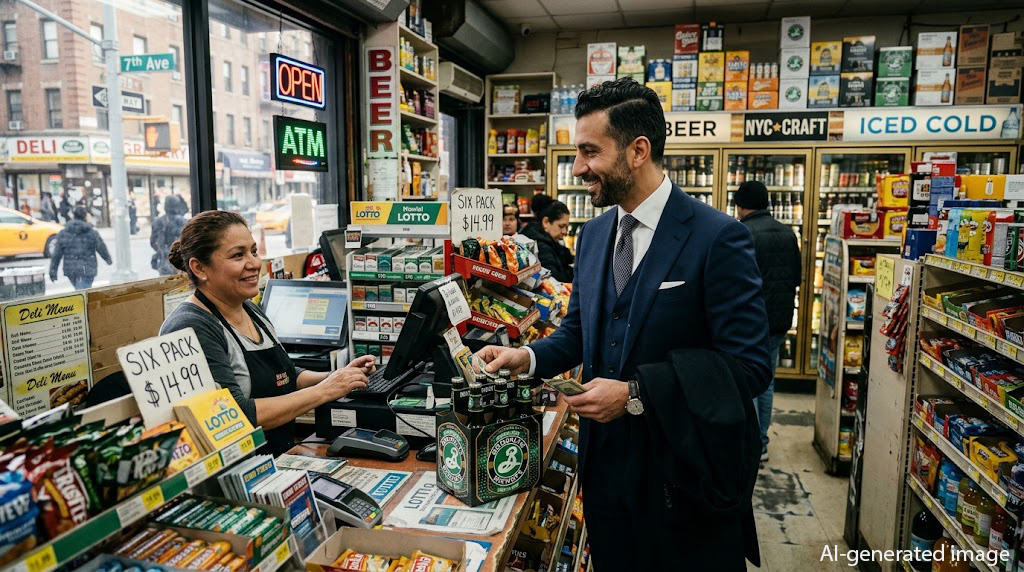
So how is a local bodega in New York City going to comply with this Advisory? How does it ensure the guy buying beer is not an Iranian government official? Or the wife or husband of that official? Does the bodega now have to run all customers buying beer against a screening list? And what list? There’s no definitive list with all the names of Iranian government officials, much less their family members and dependents.
Maybe State expects the bodega not to sell beer to anyone who sounds or looks Middle Eastern unless it’s Mayor Mamdani himself.. It seems to me unless the customer is surrounded by a phalanx of bodyguards or Secret Service agents or just happens to mention that he or she is an Iranian government official attending the current UN session, or the wife or husband of one, the bodega ought to be able to sell a six-pack of craft IPA without worries.
And what can the State Department actually do about such sales? The FMA itself provides no civil monetary or criminal penalties for violating these restrictions. Section 4311 makes it unlawful to provide a prohibited benefit, but its enforcement mechanism only gives the United States the right to bring an action to obtain compliance, “including any action for injunctive or other equitable relief.” In other words, no statutory civil fine for the merchant—not even a firm and painfully applied wet-noodle slap.
State’s deus ex machina to save the Advisory is the threat of OFAC enforcement. But that raises another problem. The State restriction expressly reaches dependents of Iranian officials, while the OFAC does not prohibit sale to a dependant of an Iranian government official. State therefore cannot assume that every transaction prohibited by its Advisory is, for that reason alone, an OFAC violation.
If the beer run is done by an Iranian UN attendee, section 560.512 of the Iranian Transactions and Sanctions Regulations allows sales of goods and services to “employees of the diplomatic missions of the Government of Iran to international organizations in the United States” unless such sale is “otherwise prohibited by law.” Whether visiting UNGA attendees can be considered employees of the mission is far from clear but not impossible. And arguably these purchases are not “otherwise prohibited by law” because, as noted above, it is far from clear that the FMA gives State authority to regulate the personal purchases of visiting Iranian officials merely because they are attending the UNGA.
Fortunately for State and OFAC and all the bodegas in New York City, Iranian government officials probably won’t be buying much beer in New York.