
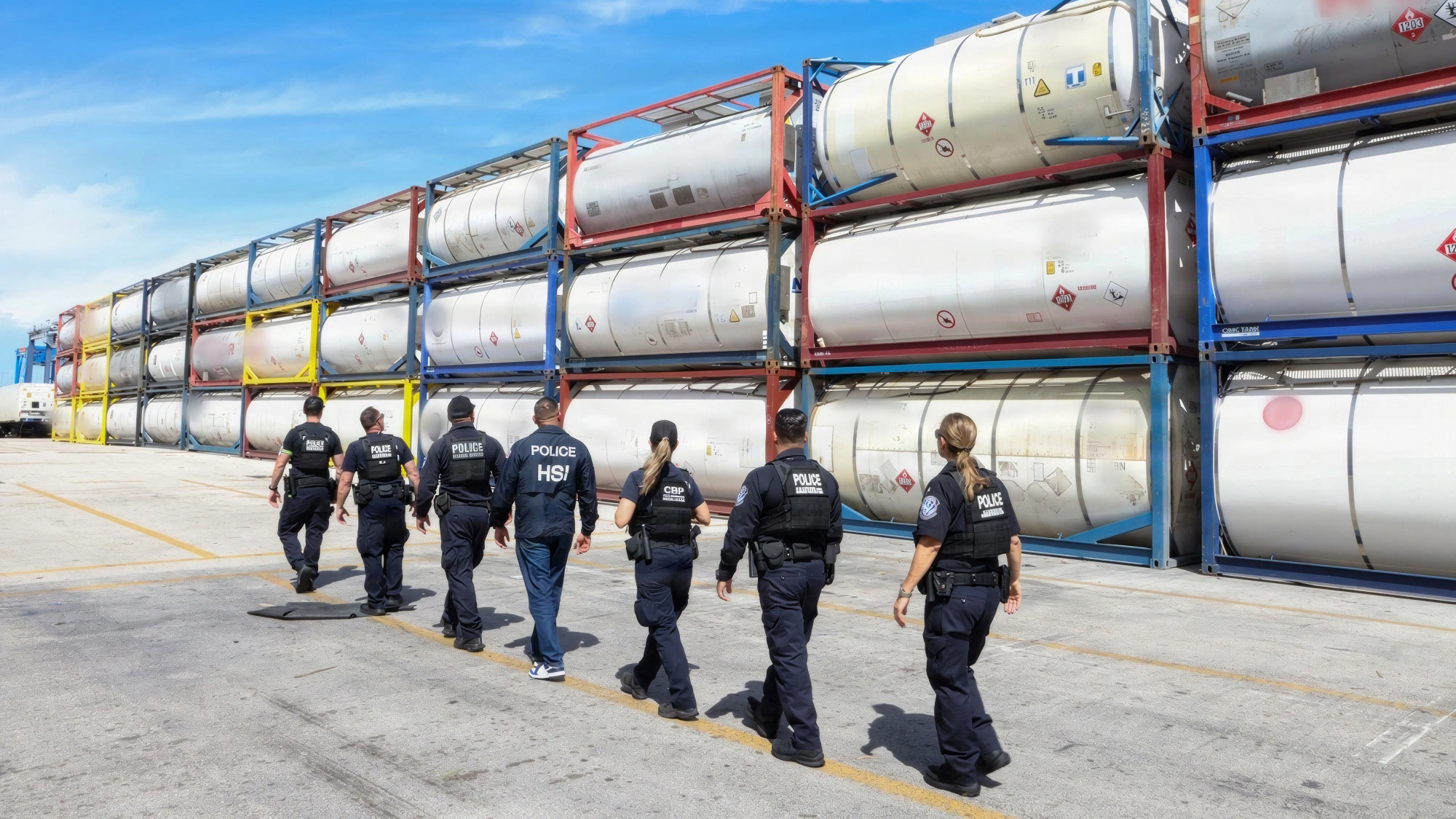
Homeland Security Investigations announced today that the U.S. government had seized at Port Everglades and Port Houston 615,000 gallons of biodiesel fuel worth $2.8 million and destined for Cuba. At a press conference on Wednesday, a U.S. official justified the seizure by claiming that the biodiesel was destined for ENETEC S.A., a Cuban oil wholesaler, as the “ultimate consignee” shown on export documents. ENETEC was blocked and added to the SDN List pursuant to a State Department announcement on July 13, 2026, made pursuant to Executive Order 14404.
There is, however, something smelly here and it is not just the ripe odor of the biodiesel fuel itself.
The first odd thing about this seizure is that the biodiesel was sitting in U.S. ports and openly bound for Cuba. The exporters were not engaged in any shenanigans to conceal the shipment, its destination as Cuba, or its ultimate consignee in Cuba as ENETEC. Clearly the exporters thought the shipment was legal. On top of that, the Miami Herald reported that it was shown a letter from OFAC authorizing the shipment.
So the question now is whether the exporters had any legitimate reason to believe that the export was legal (above and beyond the OFAC letter) or were completely out of their minds. They would have to be the latter before openly and brazenly loading $2.8 million in biodiesel on U.S. ships headed for Cuba if they did not have some reason to believe this would not land them in jail. (Take a look at the government-supplied picture above to see how openly and brazenly. It’s an awkwardly staged picture with a single-file synchronized parade of federal agents marching in front of the biodiesel barrels.)
This inquiry as to whether there is a basis for such a belief starts with Cuba GL-1 under Executive Order 14404. That EO was not separately implemented anywhere in the Cuban Assets Control Regulations (CACR) but is in effect as law only as an Executive Order. The General License says
all transactions prohibited by Executive Order 14404 are authorized to the extent such transactions are authorized or exempt under the Cuban Assets Control Regulations, 31 CFR part 515 (CACR), including transactions authorized by a general or specific license pursuant to the CACR
It also excludes “any transaction that is otherwise prohibited by 31 CFR Chapter V.” This is language often used by OFAC in general licenses to prevent the general licenses from being used for transactions with blocked parties. But there is a catch here. Although Executive Order 14404 itself prohibits transactions with ENETEC, OFAC never added its usual regulation to Chapter V making transactions prohibited by that Executive Order also prohibited by OFAC’s regulations. As a result, the prohibition on dealing with ENETEC arises under the Executive Order, not Chapter V. And GL-1 expressly authorizes transactions otherwise prohibited by that Executive Order if they are authorized under the CACR. So, assuming the requirements of section 515.533 and License Exception SCP are satisfied, ENETEC’s designation does not prevent the transaction.
Next we must pay a visit to section 515.533 of the CACR which, ahem, “authorizes” the biodiesel sale by permitting any “exportation or re-exportation . . . licensed or otherwise authorized by” BIS. It does exclude transactions “financed from any blocked account,” but there is no indication, and the government has not claimed, that these shipments were financed in that fashion..
So, in the end everything comes down to BIS’s License Exception SCP which authorizes exports of EAR99 items, like biodiesel, “for use by the Cuban private sector for private sector economic activities.” HSI has not claimed that the end users were not in the private sector. We don’t know what the OFAC letter said but it seems unlikely it would have okayed the transaction if it thought SCP did not apply.
It appears that HSI has no reason to contest this ultimate end use either, as it is hanging its raggedy hat entirely on ENETEC as the ultimate consignee. And we all know, I should hope, that ultimate consignee and end user are not the same thing, especially where the ultimate consignee is a gosh-darned wholesaler. And here is the description of ENETEC in the State Department designation:
ENETEC S.A. is a Cuban entity engaged in the import and export of fuels and lubricants.
Does that sound like ENETEC is the end user? It certainly does not to me.